
“The primacy of place in the representations of trauma anchors the individual experience within a larger cultural context, and, in fact, organises the memory and meaning of trauma.” Balaev (2008, p150)
The connection between place and trauma described by Balaev above, anchors my project in Kristiansund, a small coastal town a third of the way up the Norwegian coast. Is forgiveness tied to place? Could the symbolic return of my grandad to this small town of 25 000 people break the cycle of intergenerational trauma?
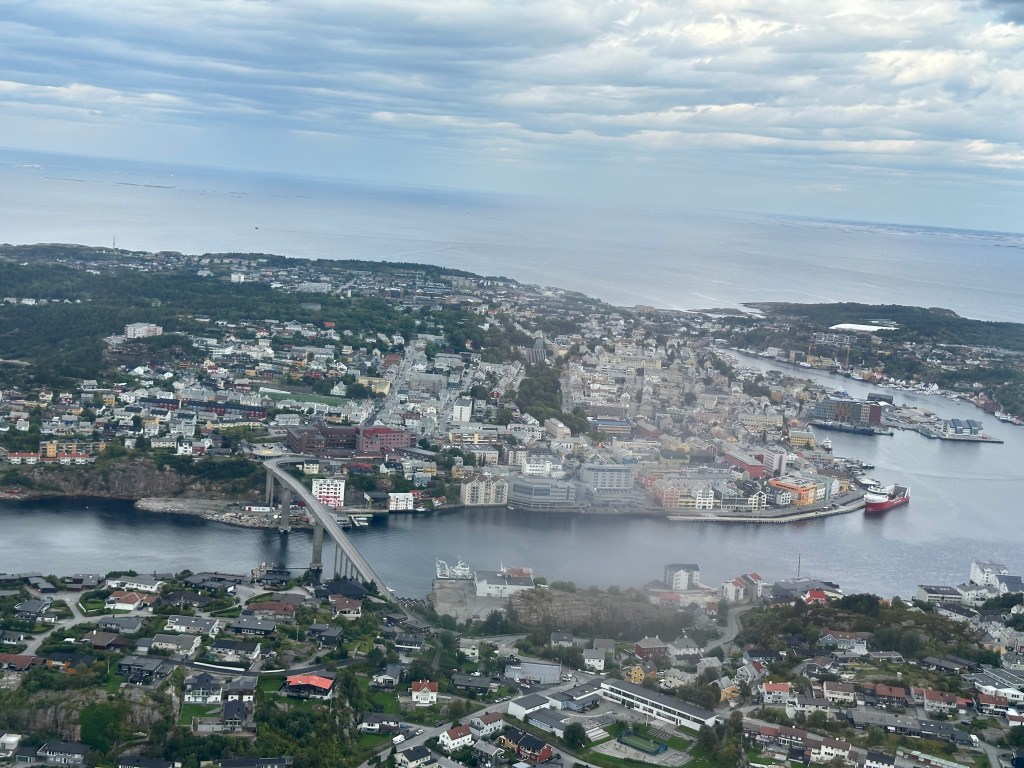
A close knit family life was shattered when my grandfather’s financial fraud was discovered in the 1960s. Stealing from the family firm must’ve felt like a huge betrayal, and the only option was for my grandad, his wife and three children to leave town. If he did that voluntarily or was forced out remains a mystery. Their absence was sorely felt amongst those left behind, and the loss of family and place connections must have been traumatic for those who departed.
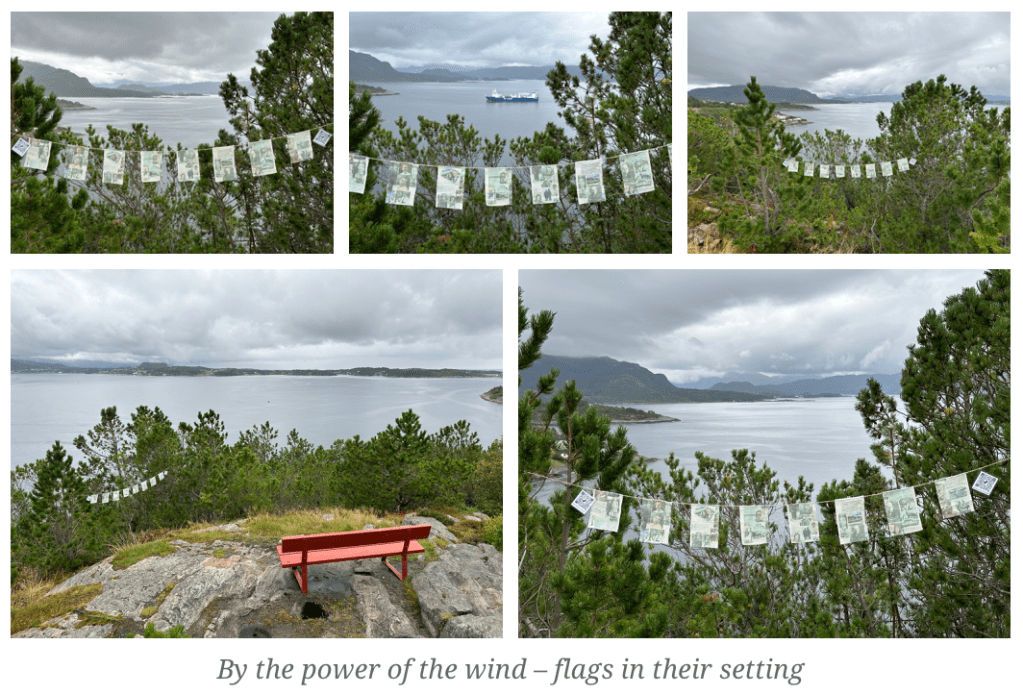
This project is a reunion, a return home for my grandad (from now on he’ll be known as Bestefar, the Norwegian word for grandad) where he’ll be immersed in the landscape he carried in his bones. Using the elements of wind, water and earth, he would yet again part of his hometown. The artwork I brought with me contained a multitude of meanings; on the face of it they represented my grandad, and his wider family while it was also infused with love, forgiveness, curiosity and apprehension. My intensions behind the project were to honour Bestefar by bringing him home while also focusing on my embodied experience of being in place.
The acts of placing the artworks in the landscape became works of art in themselves, a performance observed only by me, the artist. My embodied place experiences were both an artistic process and an artistic act. As a Flâneuse I meandered the streets and paths, confident the sites where the artwork needed to be would reveal themselves to me.
A coastal path. In the rain. If I had met anyone while walking, they would immediately have realised I was an “outsider” based on my outfit. Norwegians are always dressed for the weather when walking in nature; waterproof coats and solid boots are essential. I had trainers. And an umbrella. It felt awkward, laughable even; umbrellas don’t belong in the woods. Even I, as an urban dweller, know that. I felt like an outsider, unsure, not quite settled into my surroundings, not fully confident in my process of placing art in a public place. But the fork in the path was fortuitous; should I walk left or right? I chose right and ended up at “utsikten” – a viewing point where I immediately felt a sense of relief. And joy; the flags belonged here, in that specific spot. And with that, the project became alive, a joyous and immersive process, an exploration of the ancestral landscape.
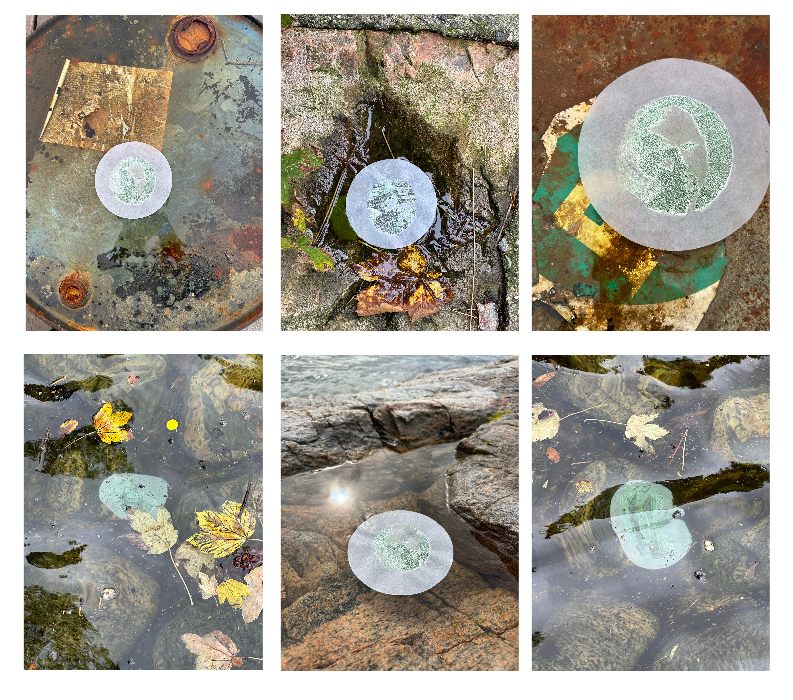
Creating connections across time and place was a big part of this project, hence my decision to create these portraits of Bestefar (below) from chemistry testing papers I bought in a charity shop on my previous visit to Kristiansund in 2023. Returning them, and placing them in the landscape, meant the papers came full circle, they came home. Just as Bestefar’s journey ended back where he started, in his hometown.
The paper portraits were placed in water to utilise the highly absorbent quality of the papers themselves. Initially they floated on the surface, but as water permeated they became heavy and sank, fully immersed in the water whether a small puddle, a fountain or the sea. The paper will eventually dissolve leaving fragments of Bestefar free to float away in the sea, or blow away as the puddles dry up.
Placing these portraits in water created an ever-changing art installation. The film below show the portrait in the town fountain. As the water from the waterfall hits the surface, it creates ripples that moves leaves, pine needles and pine cones across the surface, helped by the very strong wind that creates the soundtrack for this video. It became an ever-changing installation, totally out of my control, as the portrait merged with the water.
I brought two pebbles with me, both with an image of Bestefar. These tactile objects personified his spirit, they became him – I held the pebble and spoke to it as if it was Bestefar. As I gently placed the stone on the seaweed as the tide was coming in, I watched as the waves washed over his face, distorted it, moved the seaweed, and the stone. Every movement of the water changed the way he looked, distorted and restored his face, the moment of the waves dissolving his essence in the water.
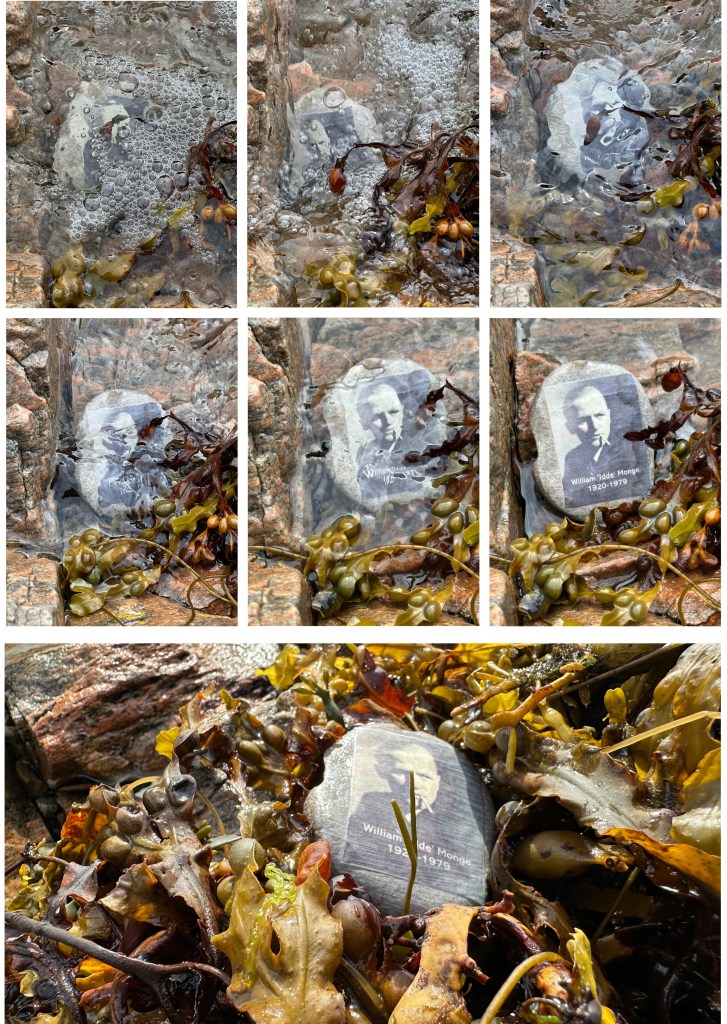
When I returned to this spot a day later, he (the stone) was gone, washed away by the tide. I had expected him to still be there and his absence brought with it a sense of abandonment, of loss, These visceral emotions surprised me, left me tearful and childlike in my loneliness, while at the same filling me with love and respect for the ancestral voices permeating the landscape.
The final, and a very poignant aspect of the project, was to reunite Bestefar with his family, at the family grave. His parents and siblings are all laid to rest here, together, and as an act of forgiveness he was reunited with his family. Bestefar wrote a song about his hometown, and how he longed to go back if he could find the courage. It was written just before he died. He never went back. Until now. I buried a piece of organic hemp fabric, the same material as the flags were made from. The lyrics of the song was written on it. As the fabric decompose it will blend with the soil that holds his ancestors’ remains. In front of the gravestone I placed another stone with his image and the dates of his birth and death, an alternative gravestone to signify his spiritual return to his family, and the town he never wanted to leave.
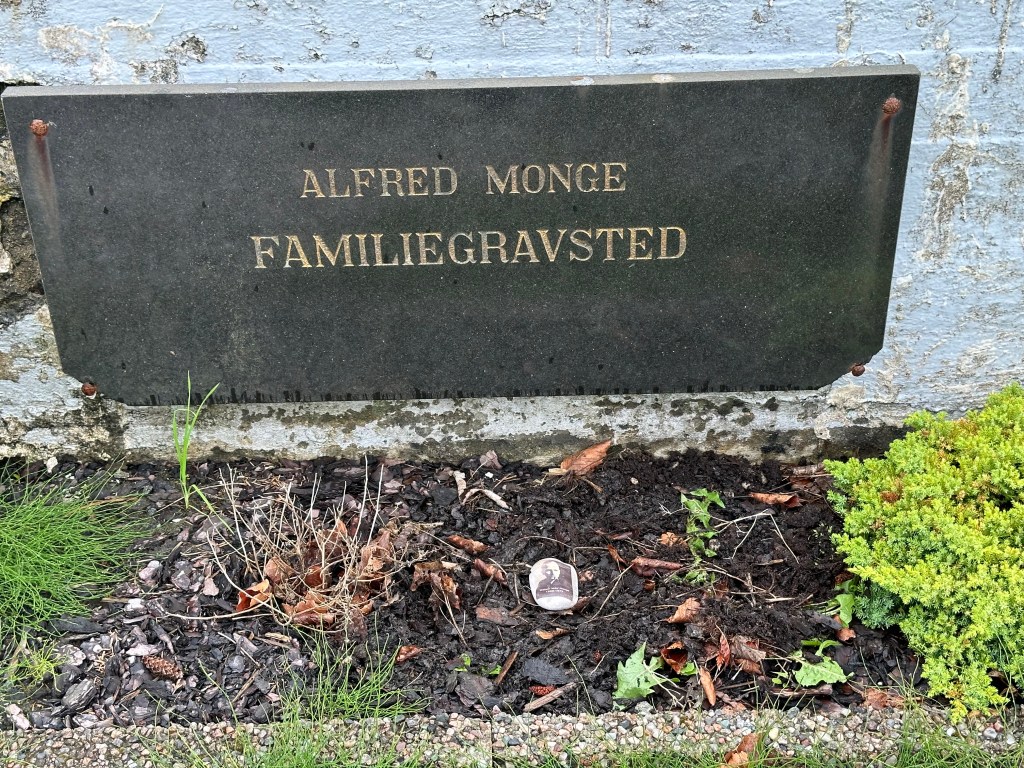
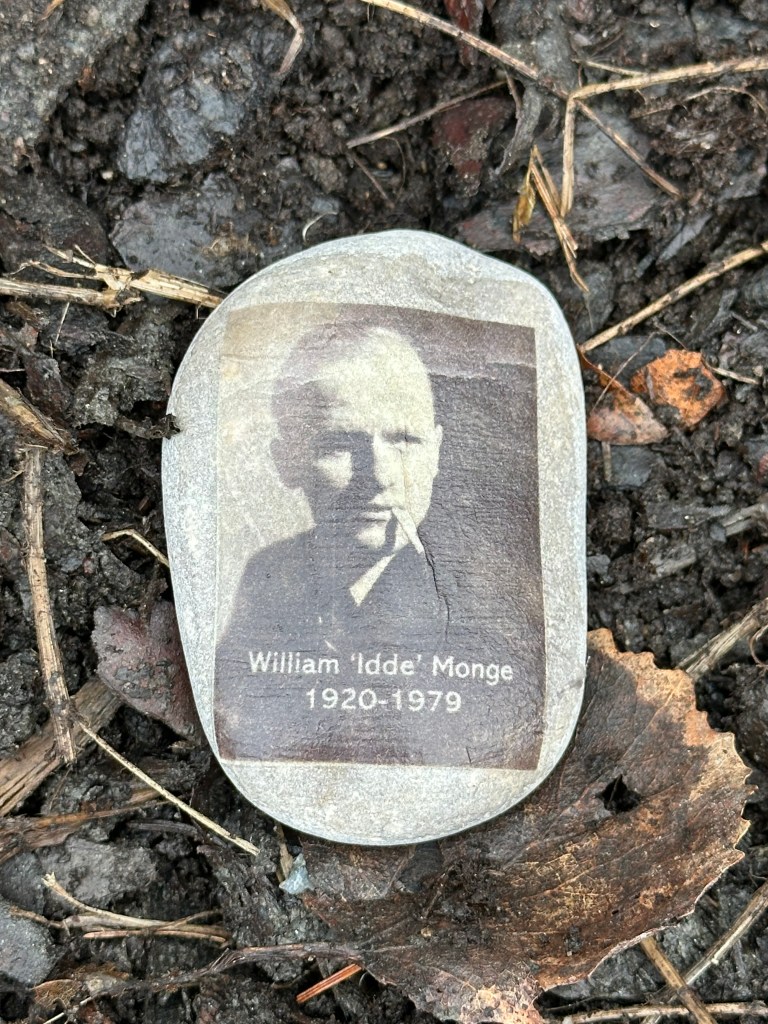
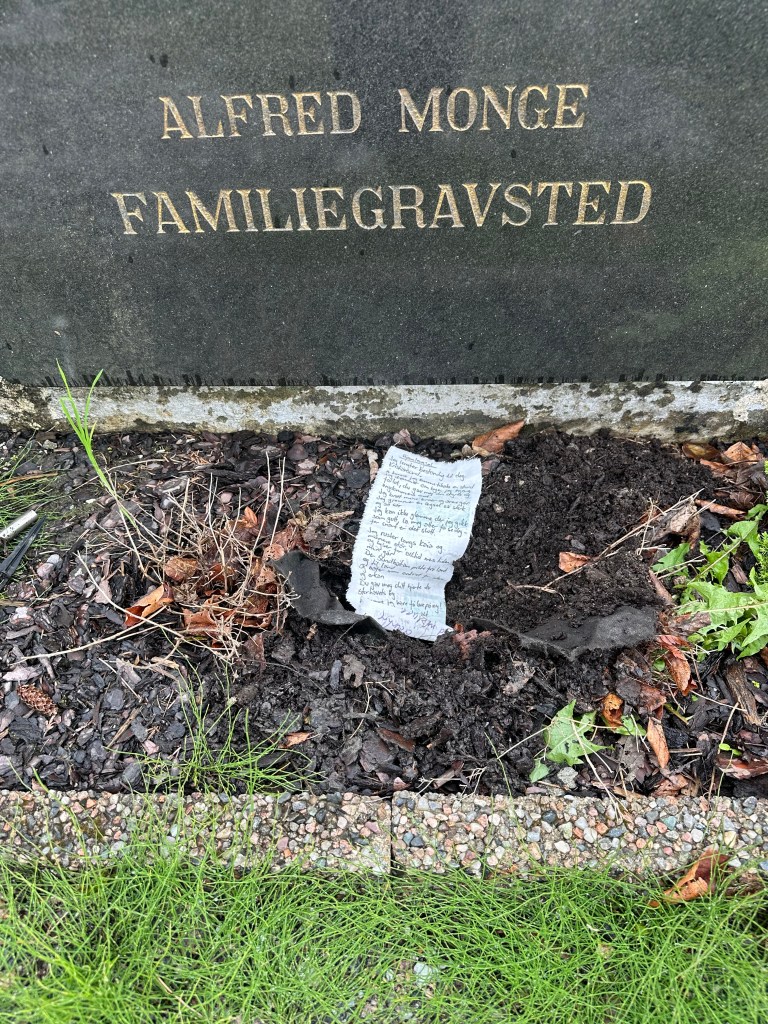
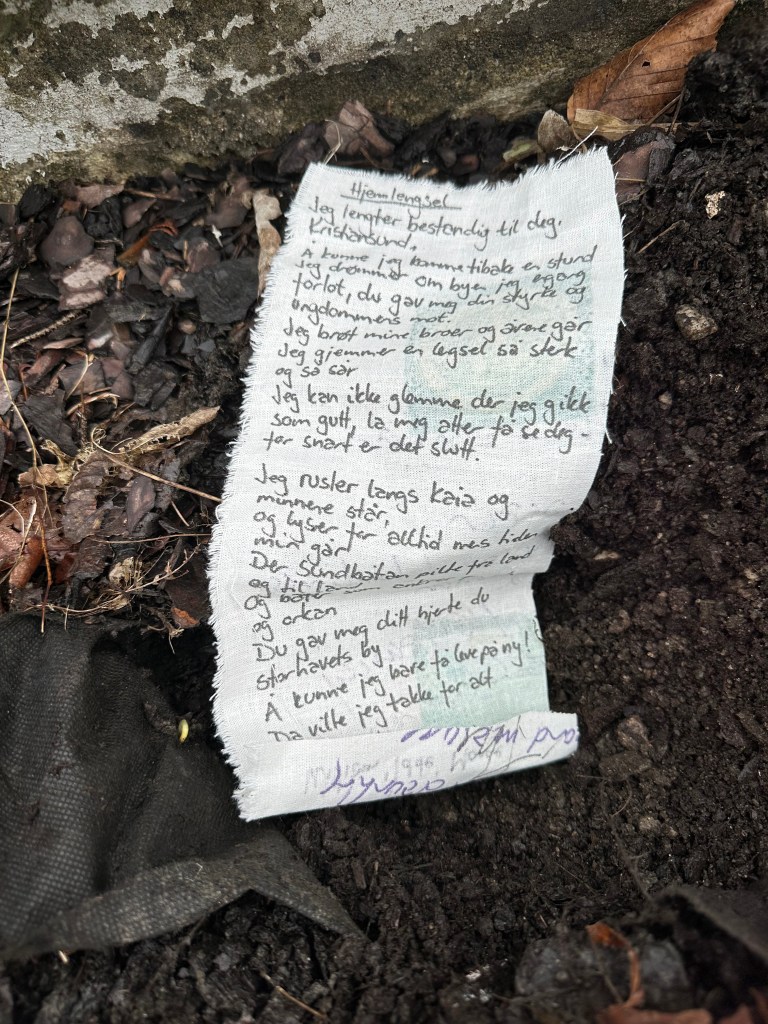
Bestefar’s return was one aspect of my process based art practice that will culminate in an exhibition in January 2025. By bringing him home I wanted to draw attention to the intergenerational trauma my family is struggling with. Whether it all stems from his alienation and displacement can never be proven, but I hope this act of love and honour can contribute to break the cycle of substance abuse, suicide and mental health struggles subsequent generations are dealing with.
The South African poet Diana Ferrus campaigned tirelessly to have the remains of Sarah Baartman returned to South Africa. I discovered the poem she wrote about Baartman as I was preparing this project. The final verse is one of hope, of closure, and of love, and echoes my relationship with Bestefar;
I have come to take you home
where I will sing for you,
for you have brought me peace,
for you have brought us peace.
DIANA FERRUS;
I’VE COME TO TAKE YOU HOME 1998
Sources:
Balaev, M. (2008). Trends in Literary Trauma Theory. Mosaic: An Interdisciplinary Critical Journal, 41(2), 149–166. http://www.jstor.org/stable/44029500 (Accessed: 27 July 2024).
https://youtu.be/cBnz9nXG17E?si=wBXxQqMbs3cj6IfE
https://www.sahistory.org.za/people/sara-saartjie-baartman
 Trine Monge Wade - Artist